
The Territory Got Bigger. The Expedition Team Got Smaller.
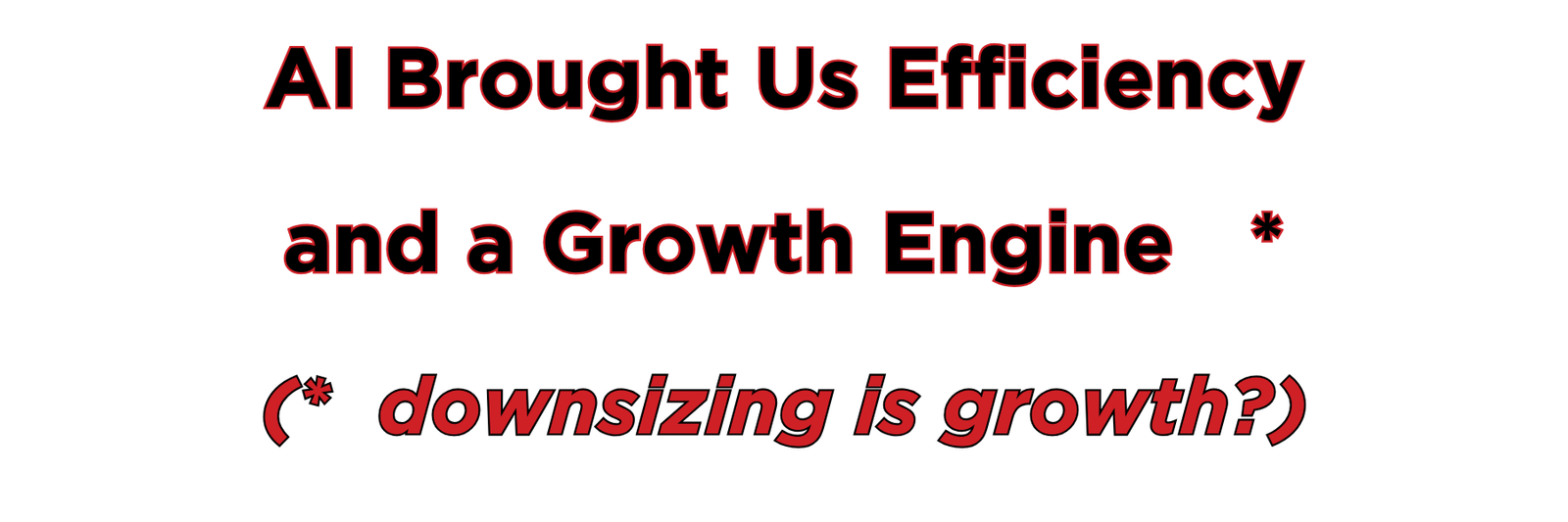
AI Brought Us Efficiency
and a Growth Engine *
(* downsizing is growth?)
For as long as companies have had ideas, they have had a way to kill them.
It wasn’t called a filter. It was called a budget meeting. A resourcing conversation. A “we don’t have the bandwidth right now” email that arrived on a Thursday and was never followed up on.
The filter had a real name: execution cost.
Every idea that survived had to clear the same bar. It needed engineers. Product teams. Coordination. Time. Meetings about the meetings. The bar wasn’t set by ambition. It was set by what the company could afford to attempt.
Most ideas didn’t make it. The ones that did were the safest ones.
That was the game. Everyone knew the rules. Then AI showed up and changed them.
The Territory
When execution cost drops, something happens that a map can’t show you.
Territory appears.
Not roads to places you already knew about. Actual ground that wasn’t reachable before. Ideas that used to be too niche to staff became buildable. Products too experimental to justify a team became testable. Markets too small to enter became worth entering. Experiments that used to take months started taking days.
The excuse that had killed a thousand ideas — we don’t have the bandwidth — stopped being true.
AI didn’t just make existing work cheaper. It created territory that didn’t exist before. You could go there. Build there. Stake a claim.
The logical response was obvious. Send the expedition.
The Expedition
Here is what many companies did instead.
They looked at the new territory, calculated what it used to cost to run the old routes, and reduced the expedition team accordingly.
The press release used the word “growth” twice. The efficiency gains were real. The savings were real. The column in the spreadsheet filled up fast.
The other column — the one for where the expedition could go — stayed empty.
A few companies read the territory differently. One announced it was nearly doubling its workforce because AI made more possible, not less. The CEO said it without apparent irony: “Companies are debating whether to hire more people or just invest in AI. We are doing both.”
Both. As in addition. As in the territory is bigger and we need more people to explore it.
It landed like a foreign language.
The Old Logic in the New World
The mistake isn’t about AI. AI did exactly what it was supposed to do.
The mistake is about thinking. Specifically, thinking built for scarcity applied to a moment of abundance. Companies spent decades filtering ideas through execution cost. That logic got very efficient. Very automatic.
So when execution cost dropped, the logic kept running. It just found something else to cut.
AI created territory that nobody had ever stood on. Companies responded by reducing the number of people who could explore it. The ground changed. The players went back inside.
Classic Logic Need Not Apply.
The Punchline
For years companies said they were limited by bandwidth.
Then the bandwidth arrived.
The reaction was a headcount reduction.
Logic to Apply
AI didn’t eliminate the cost of ideas.
It eliminated the excuse for not trying them.
The territory is there. The filter is gone. The bandwidth conversation has no ground to stand on anymore.
What’s left is the question nobody put in the spreadsheet: where do you actually want to go?
The expedition team is waiting. Some of them, anyway.
Editor’s Note: AI expanded my territory into a world where Logic Need Not Apply and Make It A Better Day could actually exist. Jojo and I keep debating whether that’s a good thing or not.
Share This Article (confuse your friends & family too)
Support the Absurdity

Share the Eye Rolls
Documenting AI absurdity isn’t just about reading articles—it’s about commiserating, laughing, and eye-rolling together. Connect with us and fellow logic-free observers to share your own AI mishaps and help build the definitive record of human-AI comedy.
Absurdity in 280 Characters (97% of the time) —Join Us on X!
Find daily inspiration and conversation on Facebook
See AI Hilarity in Full View—On Instagram!
Join the AI Support Group for Human Survivors
Thanks for being part of the fun. Sharing helps keep the laughs coming!